Owners ask how much a customer is worth and how much they should spend to get one. Here are the numbers, the math, and what flying blind on them actually costs.
How much is a customer worth to my business?
It's one of the most-typed questions in small business, and most owners can't answer it within a factor of two. That's not a knock. Nobody hands you the number. You have to build it.
But until you have it, you can't answer the question that follows it: how much should I spend to get a new customer? Every ad budget, every referral fee, every discount is a guess.
This post is the numbers version. What the research says, the math for a typical owner, and what it costs to keep guessing.
The research: keeping customers is where the money is
Start with the economics of retention, because it's the part most owners underweight.
- Acquiring a new customer costs 5 to 25 times more than keeping an existing one (Harvard Business Review, 2014).
- Bain & Company research found that raising retention by 5% raises profits by 25% to 95% (Harvard Business Review, citing Bain, 2014).
- HubSpot reports that 72% of company revenue comes from existing customers and 28% from new ones (HubSpot Sales Strategy Report, 2025).
- For subscription businesses, failed payments alone cause 20% to 40% of churn (ProfitWell, via GrowSurf).
Read those together and the lesson is plain. A customer's value is mostly in the second, third and tenth purchase. If you only measure the first sale, you'll underspend on keeping people and overspend on finding new ones.
The math for a typical owner
Here's a simple illustration. Use your own numbers; these are round on purpose.
A home service company charges an average of $400 a job. After materials, labor, card fees and drive time, it keeps $140. That's a 35% contribution margin.
A typical customer books 1.5 times a year and stays about three years. That's 4.5 jobs over a lifetime.
- Lifetime value: $140 margin x 4.5 jobs = $630.
- Acquisition cost: $3,000 a month in ads and lead fees brings 20 new customers = $150 each.
- LTV to CAC: $630 / $150 = 4.2 to 1. Healthy.
Now change one thing. Repeat customers drop because nobody follows up, and lifetime falls to 1.5 jobs. LTV is $210. The same $150 acquisition cost now leaves $60 to cover overhead and profit.
Same business, same ads, same price. A third of the profit per customer gone, and nothing on the monthly P&L would tell you exactly why.
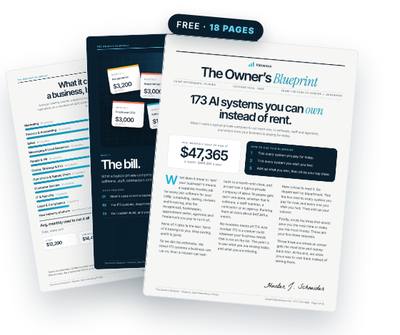
Get the free Owner’s Blueprint
173 systems most businesses rent, what each one replaces, and what it costs a typical 10-person company every month. Tick what you pay for, circle three, and see what owning them would look like.
Download the free Blueprint →How much should I spend to get a new customer?
Once you know LTV, the answer is a formula, not a feeling.
A common rule of thumb is to keep acquisition cost at or below a third of lifetime value, and to get it paid back from margin within 12 months. Faster if cash is tight.
In the example above, that means up to about $210 per customer when retention is strong, and about $70 when it isn't. Retention literally sets your marketing budget.
This is why owners who say "I'm spending more on ads than I make per customer" are often right. Their ad cost didn't change. Their customer value fell, and they didn't have the number to notice.
Pricing: the cost of a guess
The second big cost is pricing by feel. Bank of America found that 64% of inflation-affected owners are raising prices (Bank of America Business Owner Report, 2025). QuickBooks found businesses hit hardest by late payments raised prices by an average of 16%, versus 10% for others (Intuit QuickBooks, 2025).
Those are blanket moves. A model would show that some services need far more than 16% and some need nothing. Raising everything evenly loses price-sensitive customers on work that was already profitable, while the loss-making work stays underpriced.
A two-point margin error on $1 million of revenue is $20,000 a year. On most small businesses, that's the owner's raise.
What flying blind adds up to
Add up the three leaks for a business doing around $1 million a year. These are illustrative, not study findings:
- Overspending on a channel whose customers never return: often thousands a month.
- Two points of margin lost to under-priced services: about $20,000 a year.
- Retention never funded because nobody can show its return: the biggest number, and the hardest to see.
Compare that with the cost of the model itself. Our Blueprint estimate for renting unit economics software is about $65 a month for a typical 10-person company, or $3,900 over five years. A consultant's one-time pricing study often costs more than that and is stale within a year.
The cheap part is the tool. The expensive part is not having it, because every one of those leaks compounds month after month while the business looks busy and healthy from the outside.
Five signs your customer value is quietly falling
You don't need the full model to suspect a problem. These are the patterns owners describe right before they run the numbers:
- Ad spend is up and new customers are flat. Your acquisition cost is rising even if the dashboard says clicks are fine.
- Your best customers from three years ago have gone quiet. Nobody noticed because new customers filled the calendar.
- Discounts have become permanent. The first-time promo turned into every-time pricing, and margin per sale dropped with it.
- Fees grew faster than prices. Card fees, platform fees, shipping and lead fees each crept up a little. Together they took a few points of margin.
- You can't say which service makes the most money. If the honest answer is a guess, the mix is probably shifting without you.
Any two of these together usually mean lifetime value has dropped and acquisition cost has risen at the same time. That combination is exactly how growing sales turn into shrinking profit.
The good news: each one is fixable once you can see it, and most fixes cost less than another month of the ad budget.
Rent vs own: the numbers
Renting analytics software works if you're a subscription company with clean data in one billing system. Most owners aren't. Their revenue is in a payment processor, their costs are in bookkeeping software, their acquisition spend is split across Google, Meta and a lead service.
An owned model connects those sources inside your own accounts and does the math the way your business actually works, by job type, location, product or membership tier.
You still pay for the underlying tools you use, like your bookkeeping software and any AI usage. What you stop paying for is a separate analytics subscription that doesn't fit, and the spreadsheet hours to keep it current.
And because it's built in your own accounts, it doesn't disappear if you stop paying anyone.
The number you want on Monday morning
Here's the after-state. You open one view and see four lines: what a customer is worth by channel, what you paid to get one last month, months to payback, and margin per job type.
When an agency pitches a bigger ad budget, you know the ceiling. When a supplier raises prices, you know which services to reprice and by how much. When someone asks what your business is worth, you can show customer value and payback, the numbers buyers ask for.
That's what knowing your customer's worth buys you: control over every dollar you spend to get the next one.
Questions owners ask
How do I calculate customer lifetime value for a small business?
Multiply the margin you keep on an average purchase by the number of purchases a typical customer makes over their whole relationship with you. Use margin, not revenue, or the number will mislead you.
What's a good LTV to CAC ratio?
A common benchmark is 3 to 1 or better, with acquisition cost paid back from margin within about a year. Below that, growth tends to eat cash.
How much should I spend to get a new customer?
Work backward from lifetime value. If a customer is worth $600 in margin, spending up to about $200 to acquire them is generally sound; spending $500 leaves almost nothing for overhead and profit.
Is this only for subscription businesses?
No. Contractors, salons, gyms, clinics and ecommerce stores all have repeat customers and acquisition costs. The math works the same; the inputs come from different systems.
Get the free Owner’s Blueprint
173 systems most businesses rent, what each one replaces, and what it costs a typical 10-person company every month. Tick what you pay for, circle three, and see what owning them would look like.
Download the free Blueprint →Keep reading
Sources
- Acquiring a new customer is 5 to 25 times more expensive than retaining an existing one — Harvard Business Review, 2014
- A 5% increase in customer retention increases profits by 25% to 95% (Bain & Company research) — Harvard Business Review, citing Bain & Company, 2014
- 72% of company revenue comes from existing customers — HubSpot Sales Strategy Report, 2025
- Failed payments cause 20% to 40% of subscription churn — ProfitWell, via GrowSurf
- 88% of small and mid-sized business owners are affected by inflation; 64% of those are raising prices — Bank of America Business Owner Report, 2025
- 30% of small businesses hit hardest by late payments raised prices (average 16%), versus 21% of others (average 10%) — Intuit QuickBooks Small Business Late Payments Report, 2025
Written by Hunter J. Schneider, founder of Valuexus. Get your free 173-point AI audit.