Ramp, Brex and Vendr are good products. They were built with particular kinds of companies in mind. Here's a fair look at each for a small business, and what owning spend analysis looks like instead.
Ramp vs Brex spend tracking: the real question
Owners searching "ramp vs brex" usually want one thing: to finally see where the money goes and stop paying for things nobody uses. Both products can help. So can a few other options. The right choice depends less on features than on one question: what share of your spending would actually run through the tool?
Below is a fair look at the main options, roughly what they cost, and the gap each leaves for a 5 to 50 person business. Pricing changes often, so check each vendor's current page before deciding.
A quick way to answer it: add up last year's spend by payment method. Card purchases, ACH and checks to suppliers, payroll, rent, loan payments. For many service businesses and restaurants, card spend is a minority of total outflows, and the biggest vendors get paid by bank transfer. A card-based tool will see the minority clearly and the majority not at all.
That doesn't make card platforms a bad choice. It means they solve part of the problem, and you should know which part before you switch.
Ramp
Ramp is a corporate card and spend-management platform: cards for employees, receipt capture, expense policies, bill pay, accounting sync, and tools that surface recurring vendors and price changes. Its core product is known for carrying no monthly software fee, with a paid tier (Ramp Plus) for more advanced controls.
Where it shines: if your team spends on cards, Ramp gives you clean, categorized, real-time visibility and can flag duplicate subscriptions on its cards.
Where it falls short for a small business: it sees spend that runs through Ramp. Supplier invoices paid by ACH from your bank, tools still on the owner's personal card, and app-store subscriptions stay outside the picture unless you move them. Corporate cards also come with eligibility requirements that some small businesses won't meet.
Brex
Brex offers corporate cards, expense management, bill pay and business banking features, with a history of serving startups and a push into larger companies. Like Ramp, it offers entry-level access without a heavy software fee, with paid tiers for more.
Where it shines: card controls, global spending, and companies that want banking and cards in one place.
Where it falls short: the same coverage problem. It analyzes what flows through Brex. For a contractor or restaurant whose biggest costs are supplier invoices, the card is a small slice of total spend.
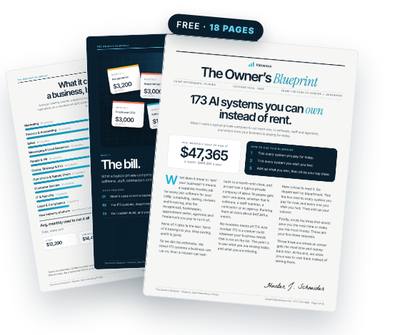
Get the free Owner’s Blueprint
173 systems most businesses rent, what each one replaces, and what it costs a typical 10-person company every month. Tick what you pay for, circle three, and see what owning them would look like.
Download the free Blueprint →Vendr for small business
Vendr helps companies buy and renew software, using pricing data from many purchases to negotiate better deals, and manages the renewal calendar. It's designed with mid-size and larger software buyers in mind.
Where it shines: if you spend serious money on a few large software contracts, benchmarked negotiation can pay for itself.
Where it falls short: most small businesses have many small subscriptions on monthly plans, not big annual contracts with room to negotiate. The value of a negotiation service scales with contract size. It also doesn't touch supplier, insurance or service spend.
If you do have a handful of larger annual contracts, a CRM, an ERP, a phone system, it's worth knowing that renewal is your best moment to negotiate. Mark those dates and start the conversation 60 to 90 days ahead, with or without a service.
Apps that find unused subscriptions for business
Subscription-finder apps scan bank and card transactions for recurring charges and help you cancel them. Many are built for consumers, with some business versions.
Where they shine: quick, cheap, good at the first pass.
Where they fall short: they find recurring charges, but they don't know which tools your team uses, which supplier prices changed per unit, or how spend maps to your accounting categories. They're a flashlight, not a system.
QuickBooks expenses by vendor report
Your accounting software already has one of the most useful spend views: expenses by vendor, by month. It's included in what you pay.
Where it falls short: it only knows what's been recorded and categorized, it doesn't flag new subscriptions or price changes, and nobody sends it to you monthly. Only 35% of small businesses use expense tracking software at all (OnPay, 2019); the report exists, but the review habit usually doesn't.
Should I hire someone to audit my expenses?
Expense reduction consultants typically review categories like telecom, merchant processing, freight, waste and insurance, often for a share of the savings they find. In complex categories with opaque pricing, they can find real money.
Read the terms. A share of savings for a multi-year period can add up, and the review happens once. When they leave, the drift starts again.
If you hire one, give them clean data. A 12-month vendor list with amounts and categories makes their review faster and their fee easier to justify.
Where every option leaves the same gap
Each tool sees a slice: the card program sees card spend, the negotiation service sees big software contracts, the finder app sees recurring charges, the accounting report sees what's been categorized. The problem owners actually have spans all of them.
And the problem is growing. Across organizations, 70% of SaaS spend is bought by business teams rather than IT, and 66.5% of IT leaders reported unexpected charges from usage or AI pricing (Zylo, 2025). About 60% of small and mid-size businesses regretted a software purchase in the past 18 months (Capterra, 2025).
Notice that none of these options is wrong. Each is a reasonable answer to a narrower question than the one you're asking. The broad question, where does all my money go, needs something that reads every source.
What owning spend analysis looks like
An owned spend-analysis system connects to all of your data in your own accounts: every bank account, every card, your accounting software and your supplier invoices. It cleans vendor names, finds every recurring charge, tracks unit prices on your top items, and maps everything to your categories.
Once a month it sends a short list: idle tools, duplicates, price increases, renewals in the next 60 days. You decide. It doesn't require switching cards or banks, and it keeps working if you change either. Our estimate for renting spend-analysis tools is about $65 a month for a typical 10-person company; owning means you pay your own AI usage and the system stays yours.
If a corporate card makes sense for your team, keep it. The owned system simply reads that data alongside everything else.
Questions owners ask
Is Ramp or Brex better for a small business?
It depends on eligibility, how much of your spend goes on cards, and which integrations you need. Compare current terms on each site and think about what share of your total spend each would actually see.
Do I need a corporate card to track spending?
No. Cards make card spend easier to see, but a full picture comes from reading your bank accounts, cards and supplier invoices together.
Is Vendr worth it for a small business?
It's most valuable when you have large software contracts to negotiate. Businesses with many small monthly subscriptions usually get more from a regular review and cancellations.
How do you guys keep software costs down?
Owners who do it well give every tool a named owner, remove seats the day someone leaves, put annual renewals on a calendar 60 days out and review new recurring charges monthly.
Own the system instead of renting it
Valuexus builds it inside your own accounts, usually within 24 hours, and it stays yours even if you cancel. $450 a month, locked for life; your first month is $225 with code WELCOME50. 7-day, 75% money-back guarantee.
See how Valuexus works →Sources
- Only 35% of small businesses use expense tracking software (accounting software: 50%) — OnPay 2019 Small Business Finance and HR Report
- Lines of business account for 70% of SaaS spend; IT accounts for just 26.1% — Zylo 2025 SaaS Management Index
- 66.5% of IT leaders reported unexpected SaaS charges from consumption-based or AI pricing — Zylo 2025 SaaS Management Index
- Roughly 60% of SMBs made a software purchase they regretted in the past 18 months — Capterra 2025 Tech Trends Survey
- Average SaaS spend reached $4,830 per employee, up 21.9% year over year — Zylo 2025 SaaS Management Index
Written by Hunter J. Schneider, founder of Valuexus. Get your free 173-point AI audit.