You opened the card statement and found three charges you don't recognize. That isn't carelessness. It's how modern software is sold, and it's fixable.
"Paying for software I forgot I signed up for"
It usually starts with a charge you don't recognize. Then you find two more. A scheduling tool from a trial in 2023. A design app an ex-employee used. A second seat on a CRM nobody logs into.
If that's you, you're not bad with money. You're running a business in a market designed to make subscribing effortless and canceling forgettable.
This post explains why it happens, what it really costs, and what it looks like to see every recurring charge in one place, permanently.
Death by a thousand subscriptions
No single subscription hurts. That's the trick. A $19 tool, a $39 tool, a $12-per-seat tool times six people. Each one is small enough to approve without thinking and too small to review every month.
Add them up and the picture changes. In larger organizations, average SaaS spend reached $4,830 per employee, up 21.9% in a single year (Zylo, 2025). Small businesses aren't immune; they just don't have anyone tracking it.
Small business payments to tech services, including AI, rose nearly 8% year over year as of October 2025 (Bank of America Institute, 2025). And 75% of small and mid-size businesses plan to increase software spend over the next 18 months (Capterra, 2025). The pile is growing whether you watch it or not.
The math is quiet but steady. Ten forgotten tools at $25 a month is $3,000 a year.
Why it happens: the mechanism
- Anyone can buy. A card on file and a free trial are all it takes. Across organizations, lines of business account for 70% of SaaS spend, while IT accounts for just 26.1% (Zylo, 2025). In a small business, that means software gets bought by whoever needs it that day.
- Trials convert silently. The free trial ends, the card gets charged, and the confirmation email goes to someone's inbox, or someone who's since left.
- Usage pricing drifts. 66.5% of IT leaders reported unexpected charges from consumption-based or AI pricing (Zylo, 2025). The bill you approved isn't the bill you're paying.
- Charges are scattered. Some tools bill your business card, some the owner's personal card, some come through an app store, some are annual and only show up once a year.
Put those together and no single statement ever shows you the whole picture.
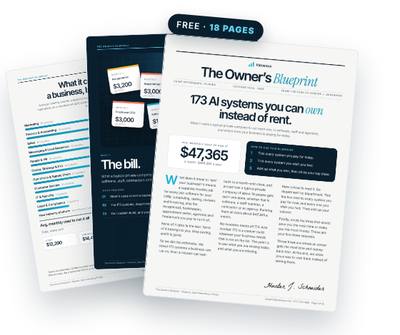
Get the free Owner’s Blueprint
173 systems most businesses rent, what each one replaces, and what it costs a typical 10-person company every month. Tick what you pay for, circle three, and see what owning them would look like.
Download the free Blueprint →Where does all my money go every month?
Software is just the most visible leak. The same pattern shows up with suppliers, insurance, phone lines, merchant fees and maintenance contracts: small, recurring, rarely reviewed.
Rising costs make it worse. 77% of small employer firms reported rising costs of goods, services and wages, or tariff-related increases, as a financial challenge (Kansas City Fed, 2025). When every vendor raises prices a little, and nobody compares this year's invoice to last year's, the business absorbs it quietly.
Most owners know their revenue to the dollar. Far fewer can name their top 20 vendors and what each cost last year.
There's also a human reason. Canceling feels like admitting a mistake, and reviewing feels like a project. So owners defer it, every month, and each month the list gets a little longer and a little harder to face. The longer it goes, the bigger the cleanup feels, which is exactly why it keeps getting put off.
SaaS bills adding up to more than rent
Agency owners say this one out loud, but it's true in plenty of service businesses. Project management, design, file storage, video, proposal software, time tracking, a CRM, an email platform, an AI writing tool, and per-seat pricing on most of them.
Each tool was added for a good reason by someone solving a real problem. Nobody ever took one away. Hire three people and the bill grows automatically; lose two and it often doesn't shrink, because nobody remembers to remove their seats.
When software passes rent, it's usually not because any one tool is expensive. It's because nobody owns the list.
What it actually costs
The direct cost is the forgotten subscriptions themselves. The bigger cost is regret spend: tools you use but overpay for, or that never delivered. Roughly 60% of small and mid-size businesses made a software purchase they regretted in the past 18 months (Capterra, 2025).
Then there's the time. Keeping track of expenses was a top financial admin frustration for 49% of early-stage owners (Tide, 2016). Only 35% of small businesses use expense tracking software at all (OnPay, 2019).
For a 10-person business, a few hundred dollars a month of unused or overpriced tools is common in our experience, and that's money that would cover a real system or a raise. Run your own numbers; the steps below show how.
What "in control" looks like
Imagine a single list, updated automatically, of every recurring charge in the business: vendor, amount, billing date, card it hits, who owns it, last time anyone used it, and whether the price changed.
Once a month, you get a short note: three subscriptions nobody has used in 60 days, two vendors that raised prices, one annual renewal coming in three weeks. You spend ten minutes deciding. Cancel, keep, renegotiate.
That's the after-state. Not a one-time purge you'll redo in a year, but a standing view that catches drift as it happens.
Then the system keeps watching, so the list never grows back behind your back.
The fix: own the spend analysis
Owners usually try one of three things: a weekend with bank statements and a spreadsheet, a spend-management card platform, or a consultant who audits expenses for a cut of the savings. All three can work. The spreadsheet decays, the platform only sees what goes through its card, and the consultant leaves.
An owned spend-analysis system reads your actual bank, card and accounting data, groups every charge by vendor, spots new recurring charges and price changes, and sends you the monthly short list. It runs in your own accounts with your own AI, and it stays yours. Our estimate is that renting tools for this runs about $65 a month for a typical 10-person company; the real prize is what the system finds.
Start with the 30-minute version below this weekend. Then decide whether you want to keep doing it by hand.
Questions owners ask
How do I see all my recurring charges in one place?
Export 12 months of transactions from every business bank account and card, plus any personal card that pays for business tools. Group by vendor and flag anything that repeats monthly or annually. A system can do this automatically from your accounting data.
How often should I review subscriptions?
A quick monthly look at new and changed charges, and a deeper review of every vendor once or twice a year, catches most waste. Put annual renewals on a calendar so they don't slip past the cancellation window.
Is it worth canceling small subscriptions?
Individually they're small. Together they rarely are. And each tool you don't need is one less login, one less data copy and one less renewal to track.
How to cut costs in a small business without firing anyone?
Start with spend you don't use or overpay for: idle subscriptions, duplicate tools, vendors who raised prices without notice and contracts that auto-renewed. That's money recovered without touching your team.
Get the free Owner’s Blueprint
173 systems most businesses rent, what each one replaces, and what it costs a typical 10-person company every month. Tick what you pay for, circle three, and see what owning them would look like.
Download the free Blueprint →Sources
- Average SaaS spend reached $4,830 per employee, up 21.9% year over year — Zylo 2025 SaaS Management Index
- Small business payments to tech services, including AI, rose nearly 8% year over year as of October 2025 — Bank of America Institute, via BenefitsPRO, 2025
- 75% of SMBs plan to increase software spend over the next 18 months — Capterra 2025 Tech Trends Survey
- Lines of business account for 70% of SaaS spend; IT accounts for just 26.1% — Zylo 2025 SaaS Management Index
- 66.5% of IT leaders reported unexpected SaaS charges from consumption-based or AI pricing — Zylo 2025 SaaS Management Index
- Roughly 60% of SMBs made a software purchase they regretted in the past 18 months — Capterra 2025 Tech Trends Survey
- 77% of small employer firms reported rising costs of goods, services and wages and/or tariff-related cost increases as a financial challenge — Federal Reserve Bank of Kansas City, Small Business Credit Survey 2025
Written by Hunter J. Schneider, founder of Valuexus. Get your free 173-point AI audit.