If you're paying for ads and can't say which ones make the phone ring, the problem isn't your marketing. It's that phone calls leave no trail unless you build one.
"No idea which ads are making the phone ring"
You're running Google Ads. Maybe Facebook too, a Yelp listing, a mailer, a truck wrap and a sponsorship at the high school field. The phone rings. Some weeks it rings a lot.
And when someone asks which of those is working, you shrug. Or you guess. Or you go with whatever the ad platform's dashboard says, which always seems to say the ad is doing great.
If that's you, you're in very large company. Only about 1 in 10 small and mid-sized businesses with growth targets track them in real time, and 70% of owners say they lack daily insight into how the company is performing (Geckoboard, 2016). Phone calls are one of the biggest reasons why.
"Spending on Google Ads but can't tell if the calls come from it"
Here's the mechanism. When someone clicks an ad and fills out a form, the click leaves a trail: a tracking tag fires, the platform records a conversion, and you can see it.
When someone sees your ad, then picks up their phone and dials the number, the trail breaks. Your phone carrier knows a call came in. Your ad account doesn't know it happened. Your website analytics don't either.
It gets worse with people who research first. 44% of consumers call a business to do more research, and 30% call because they feel most comfortable completing high-stakes purchases by phone (Invoca, 2021). The most valuable customers are often the ones whose journey ends in a phone call, which is exactly the step your reports can't see.
Why "just ask customers how they found us" doesn't work
Most owners try this first, and it's better than nothing. But it breaks down fast.
- Customers misremember. "I saw you on Google" could mean an ad, the map pack, a review site or your website.
- The person answering forgets to ask when it's busy, which is exactly when the most calls come in.
- Answers end up on sticky notes or in a spreadsheet nobody totals.
- Nobody records the calls that didn't book, so you only learn about wins.
The result is a gut-feel report that favors whatever source is easiest to remember.
Get the free Owner’s Blueprint
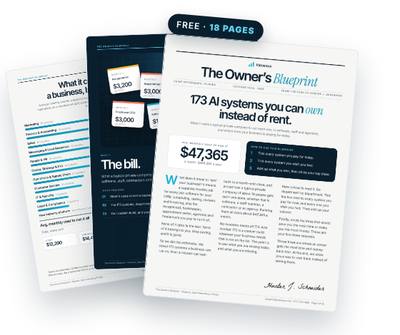
173 systems most businesses rent, what each one replaces, and what it costs a typical 10-person company every month. Tick what you pay for, circle three, and see what owning them would look like.
Download the free Blueprint →"My CSR is losing jobs on the phone and I only find out later"
The second half of the problem is what happens on the call. Even when the ad works and the phone rings, the job can still die in the conversation.
A 2026 mystery-shopper study of large home service brands found that an appointment was offered only 28% of the time where it was the natural next step, and there was no follow-up at all 72% of the time (Pied Piper, via Ainora, 2026). 42% of locations scored below 30 out of 100 on lead handling.
Those are big, trained brands. In a small shop, nobody is listening to calls at all. You find out a job was lost when the customer mentions they went with someone else, if you ever find out.
What flying blind on calls actually costs
It costs you twice. First in ad spend: if you can't see which campaigns produce calls, you can't cut the ones that don't. Money keeps flowing to the loudest dashboard, not the best source.
Second in booked work. If calls from good sources are being fumbled, more ad spend just means more fumbled calls.
And it costs you in the numbers you manage by. Small businesses that tracked metrics in real time were twice as likely to hit all their growth goals: 50% versus 24% (Geckoboard, 2016). It's hard to track anything in real time when your best lead source is a phone call nobody logged.
"Don't know how many calls we're actually booking"
That's the number that ties it together. Not calls received, but calls booked, by source. Almost no small business can say it off the top of their head.
To get it, you need three things working together: a way to know where each call came from, a record of what happened on the call, and a place where those two meet. That's what call tracking and call scoring do.
Call tracking assigns different phone numbers to different sources (an ad, your website, a mailer) so every call is tagged on arrival. Call scoring reviews the conversation and marks whether it was a real lead and whether it booked.
"How do you know which marketing is actually working?"
That question gets asked in owner groups every day, and the honest answers are usually some version of "I don't." The ones who do know have one thing in common: they connect each source to booked jobs, not to clicks or calls.
Clicks tell you people saw the ad. Calls tell you people were curious. Booked jobs tell you the money came back. An ad that produces fifty calls from tire-kickers can be worse than one that produces ten calls from buyers.
That's also why ad platform dashboards can mislead you. They count what they can see, and they can't see what happened after the phone rang. The only report that settles the argument is the one that follows a call from source all the way to an invoice.
What owning the fix looks like
Picture a Monday report that shows last week's calls by source: 31 from Google Ads, 18 from your Google Business Profile, 9 from the mailer, 4 from Facebook. Next to each, how many were real leads and how many booked. Below that, three calls worth listening to, with a one-line summary of why each one didn't book.
That report runs off tracking numbers and call recordings in accounts you own, with your own AI writing the summaries. You pay your own phone and usage costs. A typical 10-person company rents this from a tool like CallRail for around $65 a month by our estimate, before the extra features most owners end up wanting.
The point isn't the dashboard. It's that you'd finally know which spend to cut and which calls to coach.
Questions owners ask
Can't Google Ads already track calls?
It can track calls made directly from an ad or from a Google forwarding number on your site. It won't see calls from people who saw the ad and dialed your regular number later, or calls from other sources.
Will tracking numbers hurt my Google listing?
Done carefully, no. The common practice is to keep your main number as the primary on your Google Business Profile and use tracking numbers in ads and on your website.
Do I need to record calls?
Not for basic source tracking. You do need recordings for call scoring. Consent rules vary by state, so a short recorded notice at the start of calls is common practice.
Do you guys record your customer calls?
Many owners do, mainly for training and to settle disputes. The ones who get the most out of it don't just record; they have every call transcribed and flagged so they only listen to the few that matter.
Is this only for businesses with big ad budgets?
No. If you spend anything on ads and get most leads by phone, knowing which spend produces booked calls is the fastest way to stop wasting it.
Get the free Owner’s Blueprint
173 systems most businesses rent, what each one replaces, and what it costs a typical 10-person company every month. Tick what you pay for, circle three, and see what owning them would look like.
Download the free Blueprint →Keep reading
- My Cell Is My Business Phone and I Can't Turn It Off. Now What?
- Missed Calls While on a Job: Why Most of Them Never Call Back
- Flying Blind in Your Business? Why Your Numbers Show Up Months Late
- Leads Go Cold Before I Call Them Back: Why It Keeps Happening
Sources
- Only 1 in 10 SMBs with growth targets track them in real time; 70% of owners lack daily insight into performance — Geckoboard SMB Growth and Metrics Survey (2016)
- SMBs tracking metrics in real time were twice as likely to meet all growth goals: 50% vs 24% — Geckoboard (2016)
- 44% of consumers call a business to do more research; 30% prefer completing high-stakes purchases by phone — Invoca (2021)
- In home services, an appointment was offered only 28% of the time and there was no follow-up 72% of the time — Pied Piper Management Co., via Ainora (2026)
- 42% of home service locations scored below 30 of 100 on lead handling — Pied Piper Management Co., via Ainora (2026)
Written by Hunter J. Schneider, founder of Valuexus. Get your free 173-point AI audit.