Searching for the cheapest missed call text back for a small business? Here's what the usual tools do well, where they fall short, and what owning it looks like.
Missed call text back software: what you're actually buying
Type "missed call text back software" into Google and you'll get a wall of ads. Underneath the branding, they all do the same core job: when a call goes unanswered, send the caller a text from your number so the conversation doesn't die.
That job is worth doing. Across 16.7 million missed calls, 69% got no callback within 48 hours (Quo, 2026), and 82% of consumers say they'll call a competitor when a business doesn't answer (CallRail via Quo, 2026).
The question isn't whether to do it. It's which way to do it, what it really costs, and who ends up owning it.
Option 1: Your phone system's built-in auto-reply
Many business phone systems now include a basic missed-call auto-reply. If yours does, it's the cheapest place to start, because it's already included in what you pay.
Where it's good: it's fast to turn on, it sends from your real business number, and there's nothing new to learn.
Where it falls short: it's usually one fixed message. It doesn't ask follow-up questions, doesn't sort urgent from routine, and doesn't push the lead into your CRM or job software. For a solo operator that may be enough. For a crew with a real pipeline, it isn't.
Option 2: Podium
Podium is one of the best-known names in local business messaging. Its pitch is a single inbox for texts, reviews, webchat and payments, with missed-call text-back as one piece.
What it costs: Podium's listing on Capterra shows one plan, Signature, priced by custom quote (Capterra, 2026). That means you'll talk to sales to get a number, and some reviewers on that page report long contracts and trouble cancelling. Ask about terms before you sign.
Where it's good: polished app, strong review tools, a team that's done this for thousands of local businesses.
Where it falls short for a small shop: you're paying for a bundle when you may only need one piece, and you're renting it. The workflows live in Podium's account, not yours.
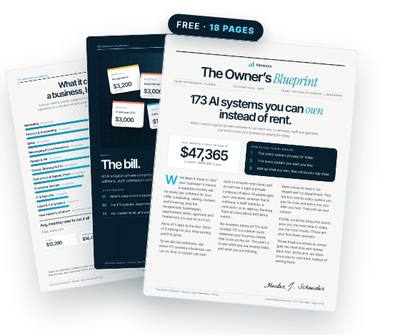
Get the free Owner’s Blueprint
173 systems most businesses rent, what each one replaces, and what it costs a typical 10-person company every month. Tick what you pay for, circle three, and see what owning them would look like.
Download the free Blueprint →Option 3: Missed call text back on GoHighLevel
HighLevel (often called GoHighLevel) is an all-in-one marketing platform, and "missed call text back gohighlevel" is one of the most watched tutorials on YouTube for a reason. It can do almost anything: CRM, pipelines, texting, funnels, automations.
Where it's good: very flexible, with a big ecosystem of agencies who build on it. If you want a full marketing system, it's powerful.
Where it falls short for a small shop: it was built for agencies, so the learning curve is real. Many owners end up paying an agency on top of the subscription to set it up and keep it running. That's two rentals for one feature.
Option 4: Phone apps and DIY automations
The scrappy route: an Android auto-respond app, a Google Voice number, or a Zapier-style automation stitched to your phone provider.
Where it's good: cheap, and you control it.
Where it falls short: personal-phone apps can send texts from your cell rather than your business line, which confuses customers. Stitched automations break quietly when one piece updates. And none of them handle the conversation after the first text.
Anyone using missed call text back, is it worth it?
That's a real question from an owner thread on Reddit, and the honest answer is: it depends less on the tool than on what happens after the first text.
Owners who say it's worth it usually have three things in common. The text comes from their real business number. It sounds like them. And someone, or something, actually reads and answers the replies within minutes.
Owners who say it wasn't worth it usually turned on a generic message, let the replies sit in an app they never opened, and saw nothing change. The text alone doesn't book jobs. The conversation does.
So when you compare tools, don't stop at "does it send a text." Ask how replies get handled at 2pm on your busiest day, and at 8pm on a Saturday.
What to look for, whichever you pick
- Sends from your business number. A text from a random number gets ignored. Hiya found 48% of consumers never answer unidentified calls (Hiya, 2025), and texts from strangers get the same treatment.
- Sounds like a person. 74% of consumers are more likely to reply if they know a real person is on the other end (Podium via Small Business Trends, 2021).
- Handles the follow-up. The first text starts it. The value is in the next three messages: what, where, when.
- Puts leads where you work. If replies live in a separate app you never open, they're lost again.
- No long contract. You should be able to walk away without a fight.
The cost of renting, over time
Our estimate for a typical 10-person company is about $125 a month for the missed-call text-back piece of a tool like Podium or HighLevel. That's roughly $1,500 a year and $4,500 over three years, and it doesn't stop.
That's not outrageous for something that saves jobs. The issue is that it never becomes yours. Your message templates, your logic, your history all live inside someone else's product. When the price goes up, you pay it or start over.
What owning the system instead looks like
There's a fourth path most owners don't know exists: have the system built inside your own accounts. Your phone provider, your own AI account, your CRM. The text-back fires from your number, the AI reads replies and asks your follow-up questions, urgent jobs ping you, and everything gets logged where you already work.
You pay your own usage for texts and AI, which is usually a fraction of a software seat. There's no license on the system itself, and it keeps running if you stop working with whoever built it. That's what we mean by replacing the subscriptions you pay for separately with systems you own.
It's not the right answer for everyone. If you love an all-in-one tool and use every feature, keep it. But if you're paying for a bundle to get one job done, owning that job is often simpler and cheaper.
Questions owners ask
What's the cheapest missed call text back for a small business?
Start with your current business phone system; many include a basic auto-reply at no extra cost. If you need follow-up questions and CRM logging, compare a rented tool against owning a system built in your own accounts.
How much does Podium's missed call text cost?
Podium's Capterra listing shows a single Signature plan priced by custom quote, so you'll need to get a number from their sales team. Ask about contract length too.
Is missed call text back worth it?
For most service businesses, yes. With 69% of missed calls going unreturned for 48 hours, even a few recovered jobs a month usually covers the cost.
Can I use HighLevel without an agency?
You can, but expect a learning curve. Many owners hire an agency to set it up, which adds a second monthly cost.
Do I need a new phone number to use these tools?
Often not. Many tools and owned setups can work with your existing business number, though some require porting or forwarding. Ask before you sign anything.
Own the system instead of renting it
Valuexus builds it inside your own accounts, usually within 24 hours, and it stays yours even if you cancel. $450 a month, locked for life; your first month is $225 with code WELCOME50. 7-day, 75% money-back guarantee.
See how Valuexus works →Sources
- 69% of missed business calls get no callback within 48 hours (16.7M missed calls analyzed) — Quo, Small Business Callback Statistics (2026)
- 82% of consumers say they will call a competitor and 78% have abandoned a business over an unanswered call — CallRail survey of 1,000 US consumers, cited by Quo (2026)
- Podium lists one plan, Signature, priced by custom quote — Capterra, Podium Pricing (2026)
- 48% of consumers never answer unidentified calls and 32% only sometimes do — Hiya, State of the Call 2025
- 74% of consumers are more likely to respond to a business's text if they know a real person is on the other end — Podium Local Business Messaging Trends, via Small Business Trends (2021)
Written by Hunter J. Schneider, founder of Valuexus. Get your free 173-point AI audit.