Every email tool can send a welcome series. The real differences are in pricing, complexity and who does the work, and that's where small businesses get stuck.
Looking for honest advice on email marketing tools
If you've searched klaviyo vs mailchimp, or mailchimp too expensive alternatives, you've seen the comparison tables. Feature grids, star ratings, affiliate links.
This is a different take. These are all good tools used by a lot of businesses. The question isn't which one is best in general. It's which one fits a business without a marketing department, and where each leaves you on your own.
Pricing on all of these changes often and depends on list size, so check current pricing pages. What follows is how each is structured and where it tends to fall short for a small team.
Klaviyo: powerful, built for teams
Klaviyo is the default for many Shopify stores, and for good reason. Its Shopify integration is deep, its flows are flexible, and its segmentation can target customers by what they bought, browsed and spent.
Pricing is mostly based on contact count, with SMS billed separately. As the list grows, so does the bill.
Where it falls short for a small business is the learning curve. Owners describe it bluntly: Klaviyo feels like too much for me right now, complexity and cost. The power assumes someone is there to use it. Without that person, many stores pay for advanced features and run two basic flows.
Mailchimp: familiar, but the bill creeps
Mailchimp is often the first email tool a business ever signs up for. It's approachable, has good templates, and works across industries, not just ecommerce.
It's also priced by contact count and plan tier, which is why owners search my mailchimp bill keeps going up. Contacts you never email still count, and some automation features sit on higher tiers.
Owners considering a switch to Klaviyo from Mailchimp are usually chasing deeper ecommerce data. That's a real gain, but it only pays off if the flows actually get built after the move.
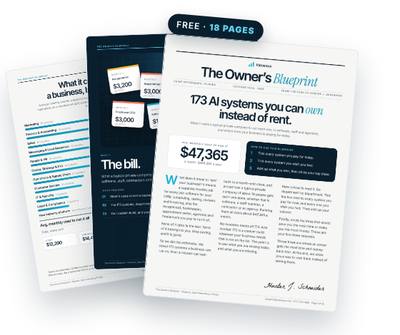
Get the free Owner’s Blueprint
173 systems most businesses rent, what each one replaces, and what it costs a typical 10-person company every month. Tick what you pay for, circle three, and see what owning them would look like.
Download the free Blueprint →Klaviyo vs ActiveCampaign for small business
ActiveCampaign leans toward service businesses and B2B: automations with if-then branching, a built-in sales CRM on some plans, and lead scoring. It's strong for drip emails to leads that didn't buy.
Klaviyo leans toward ecommerce, with tighter store data. If you sell products online, Klaviyo usually fits better. If you sell services with a quote or consult in the middle, ActiveCampaign often does.
Both share the same weakness for a small team: building and maintaining complex automations is a skill, and the software doesn't supply the skill.
Which email marketing services work well with Shopify
Shopify Email is the simplest path for Shopify stores. It's built into the admin, uses your store data and products, and covers core automations. For a beginner store, it's often enough to start.
Its limits show as you grow: less advanced segmentation and reporting than dedicated platforms. Many stores start here and graduate later.
Other Shopify-friendly options include Omnisend and Mailchimp's Shopify app. All work. Pick the one you'll actually open every week.
The freelancer or agency option
Plenty of owners search hire someone to set up Klaviyo flows. A good freelancer can build your core flows in a few weeks. We estimate ongoing freelance help at about $800 a month for a typical 10-person company, or $9,600 a year.
The risk is continuity. When the contract ends, the person who knew why every flow was built a certain way leaves, and the flows slowly go stale.
If you hire, insist the work lives in your account, with notes on every flow, and that you keep everything.
How to choose without overthinking it
Run three questions before you compare a single feature grid.
- Where do your customers and orders live? Pick the tool with the cleanest connection to that system. Data that syncs on its own beats features you'd have to wire up.
- Who will build and maintain the flows? If the honest answer is you, on Sunday nights, choose the simplest tool that runs the core five. If it's a specialist, a deeper tool can pay off.
- What will it cost at twice your list size? Contact-priced tools get more expensive as you succeed. Price the plan you'll be on in two years, not the one you start on.
If two tools tie, pick the one whose editor you find least annoying. You'll be in it every week, and friction is what stops sending.
When switching is worth the pain. Switching is worth it when your current tool genuinely blocks something you need: you can't segment by purchase history, can't connect your store, or the price at your list size is far out of line.
It's not worth it when the real problem is that flows were never built. A new login won't write them. Owners who switch for that reason often end up paying more for the same silence.
If you do switch, export everything first: contacts with tags, every template, every flow's logic written out in plain English. That export is the start of owning your system rather than having it locked in one vendor.
What every option has in common
Every tool on this list is a place to run email. None of them writes your offers, decides what to send next week, or notices that your best seller changed.
That's why the gap between owners who make money from email and those who don't is rarely the platform. It's follow-up. In a Harvard Business Review audit, 23% of companies never responded to a web lead at all (Harvard Business Review, 2011). In a 2026 test of 6,346 contact forms, two-thirds of companies never replied (Clay, 2026). Software doesn't fix that on its own.
And it has to run when customers are active: 75% of 1.69 million leads in one analysis arrived outside weekday business hours (LeadSync, 2026).
What owning the system looks like instead
Owning means the flows, templates, segments and AI prompts are built in your own accounts, on whichever sending tool suits you, and stay yours if you change vendors or stop paying anyone for help.
You still pay for the sending platform and any AI usage. What you stop paying for is someone else's version of your system. AI drafts the campaigns and keeps the flows current from your products and voice; you approve.
The practical upshot: you could start on Shopify Email today, move to Klaviyo later, and bring your system with you.
That's the shift worth making: from shopping for the perfect tool to owning a system that works on any of them.
Questions owners ask
Is Klaviyo really necessary for a small Shopify store?
No. Shopify Email or another simpler tool can run the core flows. Klaviyo earns its cost when you'll use its segmentation and data.
What's a good Mailchimp alternative if it's too expensive?
Shopify Email for Shopify stores, or other contact-priced tools with lower tiers. First, remove inactive contacts; it may drop your current plan's cost.
Should I switch from Mailchimp to Klaviyo?
If you're an ecommerce store that will actually build segmented flows, it can pay off. If your flows aren't built yet, build them first; switching won't do it for you.
Is ActiveCampaign better for service businesses?
Often, yes. Its branching automations and built-in CRM fit quote-based sales well. Ecommerce stores usually get more from Klaviyo or Shopify Email.
Own the system instead of renting it
Valuexus builds it inside your own accounts, usually within 24 hours, and it stays yours even if you cancel. $450 a month, locked for life; your first month is $225 with code WELCOME50. 7-day, 75% money-back guarantee.
See how Valuexus works →Sources
- Only 37% of 2,241 US companies answered a web lead within an hour; 23% never answered; average first response 42 hours — Harvard Business Review (2011), summarized by Ainora
- In a test of 6,346 contact and demo forms, two-thirds of companies never replied and only 5% of replies came within 5 minutes — Clay (2026), summarized by Ainora
- 75% of 1.69 million Facebook and Instagram leads arrived outside weekday 9-to-5; busiest hour 9pm; 31.5% evenings, 29.2% weekends — LeadSync (2026), summarized by Ainora
- 72% of consumers choose the business that responds first — Moneypenny call trends
Written by Hunter J. Schneider, founder of Valuexus. Get your free 173-point AI audit.