CallRail, WhatConverts and Google's free call tracking all have a place. Here's what each costs, where each falls short for a small shop, and what owning the system looks like.
"Anyone use CallRail for a small shop or is it overkill?"
That question comes up on Reddit constantly, usually from someone whose marketing agency just recommended it. The answers split into two camps: "couldn't run my ads without it" and "paid for it for a year and never logged in."
Both are true, and the difference is rarely the tool. It's whether anyone uses the data. This post is a fair look at the common call tracking options for a small business, what they cost, where they fall short, and what owning the system instead looks like.
What a small business actually needs from call tracking
Strip away the feature lists and most small businesses need four things:
- Source tagging. Every call marked with where it came from: which ad, listing or mailer.
- Recordings and transcripts. So you can hear what happened without being on the call.
- Lead and booking flags. Was it a real lead, and did it book?
- A weekly report that connects source to booked jobs, sent to you without logging in.
Number four is the one that decides whether the tool earns its keep. 70% of owners already say they lack daily insight into company performance (Geckoboard, 2016). Another dashboard you have to remember to open doesn't fix that.
CallRail pricing for a small business
CallRail is the best-known name in small business call tracking, and for good reason: it's mature, it connects to Google Ads and most CRMs, and agencies know it well.
As listed in October 2026, CallRail's plans run from $50 a month for Lead Tracking (5 local numbers, 250 local minutes, 25 texts) to $95 for Lead Tracking Complete, which adds form tracking. Lead Conversion, at $150 a month, adds AI transcription, keyword spotting and call scoring, and Lead Conversion Complete runs $195. Extra local numbers are $3 a month each and extra local minutes $0.05 (Layer3 Labs, 2026).
So the entry price is reasonable. The catch is that the features most owners actually want, transcripts and scoring, sit on the plan that costs three times as much.
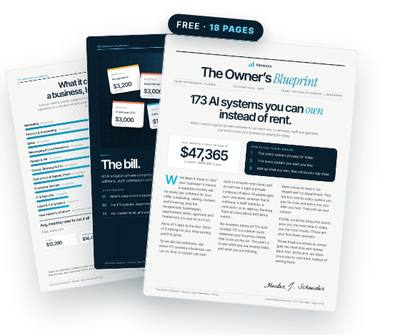
Get the free Owner’s Blueprint
173 systems most businesses rent, what each one replaces, and what it costs a typical 10-person company every month. Tick what you pay for, circle three, and see what owning them would look like.
Download the free Blueprint →Is CallRail worth it?
For a business spending real money on ads and getting most leads by phone, some form of call tracking almost always pays for itself. CallRail is a solid way to get it.
Where it falls short for small shops is less about the software and more about the fit. Usage adds up as you add numbers and minutes. The scoring is built on general rules unless you invest time training it. And the data lives in CallRail's platform, so it's only as useful as the time someone spends in it.
If you have an agency that lives in CallRail every week, it's worth it. If it'll be you, alone, once a month, think hard about what you'll actually use.
CallRail vs WhatConverts
WhatConverts is the alternative that comes up most. Its pitch is that it tracks every kind of lead in one report: calls, forms, chats and transactions, each tied to the source. Many agencies like it for lead reporting across several clients.
The honest comparison: CallRail is stronger as a call-first platform with a deeper set of phone features. WhatConverts leans toward unified lead reporting. Both use tracking numbers and dynamic number insertion, both connect to Google Ads, and both sell AI features on higher tiers. Pick based on whether your leads are mostly calls or a mix.
One practical test before you buy either: run a free trial on your two biggest sources for two weeks and see whether anyone on your team opens the reports without being reminded. If they don't, the problem isn't which tool you chose. It's that nobody owns the weekly review, and no subscription fixes that by itself.
Free and lighter options
Google Ads call tracking is free. Call assets and website call conversions record calls tied to your Google ads and can count them as conversions. It doesn't track other sources, record calls or tell you what happened on them.
Your business phone app may already include multiple numbers and call recording. Several small business phone services let you add numbers cheaply, which gives you basic source tracking without a separate tool.
Enterprise tools such as Invoca are built for large brands with call centers. Powerful, and usually more than a small shop needs.
Where renting falls short
The common problems with renting call tracking aren't about any one vendor:
- You rent your own history. Years of recordings and source data sit on someone else's platform.
- Bills creep with usage. Two-thirds (66.5%) of IT leaders reported unexpected charges from consumption-based or AI pricing, and average SaaS spend per employee rose 21.9% in a year to $4,830 (Zylo, 2025).
- Tools go unused. Roughly 60% of small and mid-sized businesses made a software purchase they regretted in the past 18 months (Capterra, 2024).
- The scoring is generic. What counts as a good call for a law firm isn't what counts for a plumber.
What owning the system looks like
Owning call tracking means your tracking numbers sit in your own phone account, recordings in your own storage, and your own AI transcribes and scores every call against a rubric written for your business. Results land in your CRM, and a Monday report arrives in your inbox or Slack without anyone logging in.
You still pay your own phone and AI usage costs. By our estimate, a typical 10-person company spends about $65 a month renting call tracking from a tool like CallRail. Owning it replaces that subscription you pay for separately, and the history stays yours even if you change phone providers.
How to choose
Spending on ads with an agency that lives in a tracking platform? CallRail or WhatConverts is a reasonable choice. Only running Google Ads? Start with Google's free call tracking. Want the data, the scoring and the reports built around your business and kept for good? Own it.
Whichever way you go, decide first who reads the report every week. That decision matters more than the tool. A great tracking platform nobody opens is just another line on the card statement.
Questions owners ask
What's a call tracking number?
A phone number assigned to one marketing source. When it rings, you know which ad, listing or mailer produced the call, and it forwards to your normal line.
Is call tracking for dental marketing different?
The mechanics are the same. Dental offices usually care most about new-patient calls and whether the front desk booked them, so scoring rules should focus on that.
Can I switch away from CallRail later?
Tracking numbers can often be ported, but recordings, scores and reports may need to be exported. Check what you can take with you before you commit.
Is a call tracking number for a small business worth it if I only run one ad?
Often yes, if that ad is a meaningful share of your spend. One tracking number on one ad tells you whether it produces booked calls, which is the only question that matters before you raise or cut the budget.
Do I need an agency to use these tools?
No. The setup is manageable for an owner. What takes time is reviewing the data every week.
Own the system instead of renting it
Valuexus builds it inside your own accounts, usually within 24 hours, and it stays yours even if you cancel. $450 a month, locked for life; your first month is $225 with code WELCOME50. 7-day, 75% money-back guarantee.
See how Valuexus works →Keep reading
- My Cell Is My Business Phone and I Can't Turn It Off. Now What?
- Flying Blind in Your Business? Why Your Numbers Show Up Months Late
- Missed Calls While on a Job: Why Most of Them Never Call Back
- Customer Info in Your Phone, Email and Sticky Notes? Here's the Cost
Sources
- CallRail Lead Tracking $50/mo (5 local numbers, 250 minutes); Lead Conversion with AI scoring $150/mo; Complete tiers $95 and $195 — Layer3 Labs CallRail pricing guide (Oct 2026)
- Extra CallRail local numbers $3/mo and local minutes $0.05 — Layer3 Labs CallRail pricing guide (Oct 2026)
- 70% of owners lack daily insight into company performance — Geckoboard (2016)
- 66.5% of IT leaders reported unexpected charges from consumption-based or AI pricing — Zylo 2025 SaaS Management Index
- Roughly 60% of SMBs made a software purchase they regretted in the past 18 months — Capterra (2024)
- Average SaaS spend reached $4,830 per employee, up 21.9% year over year — Zylo 2025 SaaS Management Index
Written by Hunter J. Schneider, founder of Valuexus. Get your free 173-point AI audit.