Chargebee, Stripe Billing, Square, Mindbody and ServiceTitan can all charge a card every month. The difference is what happens when the charge fails, and who owns the setup when you leave.
"Chargebee vs Stripe Billing" for a small business: the real question
If you searched "Chargebee vs Stripe Billing small business" or "Stripe subscriptions for a non-tech business," you've probably already noticed something. Most comparison articles are written for software companies with a finance team and a developer.
You run a gym, a salon, an HVAC company or an agency. You don't need usage-based pricing or multi-currency revenue recognition. You need three things: charge the card on time, recover it when it fails, and tell you what's still open.
Here's how the common tools stack up against that list, fairly. All of them are good at something. None of them were built around a small owner's Tuesday.
Stripe Billing: powerful, but you're the developer
Stripe is the processor behind a huge share of online businesses, and Stripe Billing adds subscriptions, invoices, a customer portal and automatic retries on top of normal card processing. It typically charges a fee on billing volume on top of standard processing.
Where it shines: reliable, well documented, smart retries, a hosted page where customers update their own cards.
Where it falls short for a small business: it assumes someone will configure it. The default failed-payment emails are generic. Texting members isn't built in. Reporting that answers "who do I need to call today?" takes setup that most owners never get to.
Chargebee: built for subscription companies
Chargebee sits on top of a processor like Stripe and adds deeper subscription management: plan changes, proration, coupons, dunning workflows and revenue reporting. Pricing is tiered and generally scales with your billing volume.
Where it shines: sophisticated plan logic and dunning, good for businesses with many plans and add-ons.
Where it falls short: for a 400-member gym or a 300-customer maintenance plan, most of the feature set goes unused, and you're paying for a second layer on top of your processor. It's also one more login that doesn't talk to your booking or field-service software without integration work.
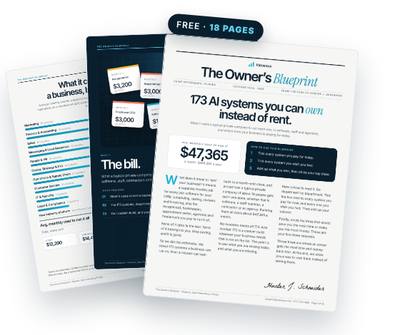
Get the free Owner’s Blueprint
173 systems most businesses rent, what each one replaces, and what it costs a typical 10-person company every month. Tick what you pay for, circle three, and see what owning them would look like.
Download the free Blueprint →Square recurring payments: easy, but shallow
If you already take cards in person on Square, its recurring invoices and subscriptions are the fastest way to start. Owners searching "Square recurring payments setup" can usually be live the same day.
Where it shines: simple, familiar, same system as your counter.
Where it falls short: recovery is basic. You get notified about failures, but the follow-up (the text, the second reminder, the call list) is on you.
Mindbody and ServiceTitan: billing inside your industry software
Gyms and studios often bill through Mindbody or a similar platform; HVAC and plumbing shops often track memberships in ServiceTitan. Owners searching "what Mindbody really costs gyms" and "ServiceTitan membership tracking" are usually weighing the convenience of one system against its price and its limits.
Where they shine: billing is tied to the schedule, the visit history and the customer record. That's valuable.
Where they fall short: they're big platforms priced for everything they do, and billing recovery is one small feature among hundreds. Customizing the messages, the retry timing or the reports usually means settling for what the platform offers.
The pattern: more tools, same leak
The common fix is to add another tool on top: a dunning add-on, a texting app, a reporting dashboard. Each one solves a slice. Together they create a stack nobody fully understands.
Small businesses are already carrying a lot of software. Average SaaS spend reached $4,830 per employee, up 21.9% in a year (Zylo, 2025), and roughly 60% of SMBs made a software purchase they regretted in the past 18 months (Capterra, 2024).
Meanwhile, the leak is still there. Failed payments cause 20% to 40% of subscription churn (ProfitWell, via GrowSurf). Integration matters more than the logo: 66% of growing SMBs have an integrated tech stack, versus 32% of declining ones (Salesforce, 2024).
Five questions to ask any billing tool before you sign
Whatever you're considering, put these five questions to the sales page or the support chat. The answers tell you more than any feature grid.
- What happens the day a card fails? Ask for the exact retry schedule and whether you can change it.
- Can it text members, from my number, in my words? Email-only recovery leaves money on the table.
- Does it warn members before their card expires?
- Can I see a list of who still owes me, today, in one screen?
- If I leave, what do I take with me? Customer records, card tokens, plan history and templates. Card tokens in particular can be hard to move between processors.
That last question is the one most owners never ask, and it's the one that decides whether you're renting or owning.
What owning the system looks like instead
Owning it doesn't mean leaving your processor. Keep taking cards wherever you take them today. The difference is that the recovery layer, the part every tool does halfway, gets built inside your own accounts and runs your way.
- Retries timed to your customers' paydays.
- Card-expiration warnings two weeks out.
- Texts and emails written by your own AI, in your voice, sent from your own number.
- An alert the day someone cancels autopay, with a pause or downgrade offer ready.
- A Monday summary: what failed, what came back, who needs a call.
Our estimate for the billing software layer at a typical 10-person company is about $130 a month. Built in your own accounts, the recovery system replaces that separate subscription. You keep paying your processor's fees and your own software usage, and the system is yours even if you stop working with whoever built it.
How to choose, honestly
If you have one simple plan and fewer than 50 members, Square or your industry software is probably enough. Just set up retries and write better messages.
If you have complex plans, add-ons and proration, Chargebee or Stripe Billing earns its keep.
If you're in the middle, a few hundred members, a couple of tiers, and the owner chasing declines, the tool usually isn't the problem. The missing piece is the follow-up system. That's the part worth owning.
Questions owners ask
Is Stripe Billing or Chargebee better for a small business?
Stripe Billing is usually enough for a business with a few simple plans. Chargebee adds deeper plan logic and dunning that pays off when you have many plans, add-ons and changes. Either way, the follow-up on failed payments still needs a process.
Can a non-tech business use Stripe subscriptions?
Yes. You can create plans and payment links without code. The harder part is configuring retries, customer messages and reports so failures actually get recovered.
Is Mindbody worth it for billing alone?
If you use it for scheduling, check-in and marketing too, billing inside it is convenient. If billing is the main reason you're paying, compare the full cost against keeping your processor and owning the recovery system.
Do I have to switch processors to own my billing system?
No. An owned system runs on top of the processor and accounts you already have. Moving processors is rarely worth the disruption.
What does Chargebee or Stripe Billing cost?
Both price by plan and typically scale with billing volume, on top of your card processing fees, and pricing changes often. Check their current pricing pages; our Blueprint estimate for the billing software layer at a typical 10-person company is about $130 a month.
Own the system instead of renting it
Valuexus builds it inside your own accounts, usually within 24 hours, and it stays yours even if you cancel. $450 a month, locked for life; your first month is $225 with code WELCOME50. 7-day, 75% money-back guarantee.
See how Valuexus works →Keep reading
- Did the Work 60 Days Ago and Still Not Paid? Here's Why
- Customers Never Check Email for Invoices? Here's Where the Money Goes
- Members' Cards Keep Declining? Here's Where the Money Really Goes
- What Failed Payments Are Really Costing Your Membership Business
- How to Set Up Recurring Billing for Your Business (and Stop Chasing)
Sources
- Failed payments cause 20% to 40% of subscription churn — ProfitWell, via GrowSurf
- Average SaaS spend reached $4,830 per employee, up 21.9% year over year — Zylo SaaS Management Index (2025)
- Roughly 60% of SMBs made a software purchase they regretted in the past 18 months — Capterra Tech Trends Survey (2024)
- 66% of growing SMBs have an integrated tech stack, versus 32% of declining SMBs — Salesforce SMB Trends Report (2024)
- Recurly recovered nearly $800 million in revenue for its customers in 2021 — Recurly, via Business Wire (2022)
- Acquiring a new customer costs 5 to 25 times more than keeping one; a 5% lift in retention raises profits 25% to 95% (Bain) — Harvard Business Review (2014)
Written by Hunter J. Schneider, founder of Valuexus. Get your free 173-point AI audit.