Being busy and being profitable are two different things. When you can't see profit per job, the busiest months can be the ones that hurt you most.
Busy all the time but no money left over
The schedule is full. The phone keeps ringing. Revenue last year was your best ever. And somehow, when you look at the bank account at the end of the month, there's barely enough to cover payroll and pay yourself something.
If that's you, you're not bad at business. You're running blind on one number: how much you actually keep on each job, product or customer. Without that number, you can work harder every year and keep less.
This is one of the most common things owners say, and it has a clear set of causes.
Do you know if you made money on a job, or just guess?
Be honest. When a job wraps, do you know what it made, to the dollar? Or do you look at the price, think about the materials, and figure it was probably fine?
Most owners guess, and the guesses run optimistic. In a QuickBooks and TSheets survey of 666 construction owners and financial experts, 60% said they felt very confident estimating project costs, yet 29% said they usually end up with less profit than they estimated (QuickBooks and TSheets survey). Confidence and results don't line up.
The same survey found 54% track project costs without software (QuickBooks and TSheets survey). That means spreadsheets, notebooks, memory, or nothing at all.
Why it happens: the leaks you can't see
Money rarely disappears in one big hole. It leaks in places a monthly profit and loss statement can't show you, because the P&L adds everything together. Here are the usual suspects:
- Labor that runs over. The estimate said two days. It took three. Nobody tracked the extra hours against the job.
- Drive time and return trips. The forgotten part, the second visit, the callback. All unbilled, all real cost.
- Change orders done on a handshake. “While you're here, can you also…” adds an hour you never invoice.
- Materials bought for one job, used on another. Receipts pile up without a job attached.
- Overhead that grew quietly. Insurance, software, the second truck, the office person. If prices didn't move with it, each job carries less.
- The wrong mix. A few big, flashy jobs can soak up your best crew for weeks at margins worse than your bread-and-butter work.
None of these show up as a line item called “money we lost.” They show up as a business that's always busy and somehow never ahead.
Get the free Owner’s Blueprint
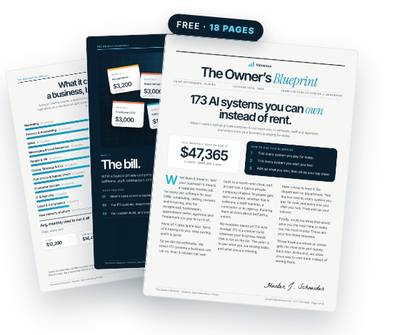
173 systems most businesses rent, what each one replaces, and what it costs a typical 10-person company every month. Tick what you pay for, circle three, and see what owning them would look like.
Download the free Blueprint →Anyone else realize their flashy jobs were the worst ones?
That Reddit thread hits a nerve because so many owners have lived it. The big remodel, the showpiece install, the client you were proud to land, and when someone finally added up the hours, it made less per day than a string of simple service calls.
Big jobs hide problems. More hours mean more room for overrun. More materials mean more receipts to lose. More time on site means more change requests. And they crowd out the smaller, steadier work that actually pays the bills.
You can't fix what you can't see. Until profit is measured per job, the flashy ones look great on the website and terrible in the bank account.
Spending my weekends piecing together receipts
Some owners try to fix it by brute force. Saturday morning, a shoebox of receipts, the bank statement and a spreadsheet. By Sunday night, you have a rough answer for last month, too late to change anything.
It isn't just you. 41% of small business owners and managers do accounting and finance themselves, and 56% of owners with fewer than six employees do everything themselves (OnPay, 2019). The weekends add up, and so does the stress: 82% of entrepreneurs say work worries have cost them sleep, with financial worries the most common cause (Adobe, 2025).
My best sellers might be losing me money on shipping
Ecommerce owners have their own version of this. The product that sells the most looks like the star of the store. Then someone adds up what it really costs to get each order out the door: the free shipping you absorbed, the packaging, the payment fee, the ad that brought the buyer, and the returns.
Shipping is usually where the surprise hides. Customers are extremely sensitive to it: 40% of US online shoppers abandoned a checkout because extra costs like shipping, tax and fees were too high (Baymard Institute, 2025). So stores absorb it to win the sale, and a heavy best seller with a thin margin can lose money on every order while the revenue chart climbs.
Restaurants see the same thing with menu items: the dish everyone orders may be the one with the worst plate cost. The pattern is identical across industries. Volume hides margin. Only per-item numbers reveal it.
What it costs you
The cost isn't only the money that leaks. It's the decisions you make without the number. You keep quoting the jobs that lose money. You chase the customers who drain you. You hire when you should raise prices, or raise prices on the work that was already fine.
Cost pressure makes it worse. 77% of small employer firms cited rising costs of goods, services and wages, or tariffs, as a financial challenge (Federal Reserve Bank of Kansas City, 2025). When costs move every quarter, last year's pricing is a guess about this year's profit.
And the data on visibility is stark: 70% of SMB owners said they lack daily insight into company performance (Geckoboard, 2016). Those who tracked metrics in real time were twice as likely to hit all their growth goals, 50% versus 24% (Geckoboard, 2016).
What knowing your profit per job looks like
Picture Monday morning. You open one page and see last week's jobs ranked by profit per labor hour. Two are flagged red: one ran 40% over on labor, one had a material cost nobody billed. Your best customer by revenue is your fourth best by profit. Your water heater installs are quietly carrying the business.
You didn't build that page. It built itself from your time tracking, your receipts and your invoices, with every cost tagged to the job it belonged to. Now you can reprice the losers, push the winners, and walk into the week knowing.
Many businesses rent pieces of this from reporting tools. Our estimate is about $75 a month for a typical 10-person company. Or you can own a system that does it inside your own books.
The smallest next step
Pick your last five completed jobs. For each one, write the price, the materials you can find, and the actual labor hours times what those hours really cost you, including payroll taxes. Subtract. You'll have five real profit numbers in about an hour, and odds are at least one will surprise you.
That surprise is the point. It's the first time you're seeing the business as it actually is.
Questions owners ask
How do I know whether I'm making money?
Look at profit per job, not just total revenue. Price minus materials, minus fully loaded labor, minus subcontractors and job-specific costs, minus a fair share of overhead.
Why does my P&L show a profit but my bank account doesn't?
Profit and cash aren't the same. Unpaid invoices, loan payments, owner draws, inventory and equipment purchases all pull cash without showing up as expenses the same way.
What's the fastest way to find a losing job type?
Rank your last 20 jobs by profit per labor hour. The bottom of that list usually shares a pattern: a job type, a customer type or a pricing habit.
Get the free Owner’s Blueprint
173 systems most businesses rent, what each one replaces, and what it costs a typical 10-person company every month. Tick what you pay for, circle three, and see what owning them would look like.
Download the free Blueprint →Keep reading
Sources
- 60% of construction owners felt very confident estimating project costs, yet 29% usually end up with less profit than estimated — QuickBooks and TSheets survey of 666 construction owners and financial experts, via For Construction Pros
- 54% of construction businesses track project costs without software — QuickBooks and TSheets survey, via For Construction Pros
- 41% of small business owners and managers do accounting and finance themselves; 56% of owners with fewer than six employees do everything themselves — OnPay 2019 Small Business Finance and HR Report
- 82% of entrepreneurs say work worries have cost them sleep, with financial worries the most common cause — Adobe 2025 Work-Life Balance Report, via Small Business Trends
- 77% of small employer firms cited rising costs of goods, services and wages, or tariffs, as a financial challenge — Federal Reserve Bank of Kansas City, Small Business Credit Survey 2025
- 70% of SMB owners said they lack daily insight into company performance; only 1 in 10 with growth targets tracks them in real time — Geckoboard SMB Growth and Metrics Survey, 2016
- 40% of US online shoppers abandoned checkout because extra costs like shipping, tax and fees were too high — Baymard Institute, 2025
Written by Hunter J. Schneider, founder of Valuexus. Get your free 173-point AI audit.